
Digital Fatigue: Rediscovering the Power of Print
Feature by LEAP Luxe (MJ Evely, Client Director)
Luxury brands are often told that younger consumers are less loyal than previous generations. Whether that’s entirely true or not, what is clear is that attention is harder to hold and easier to lose.
The default response to this has been to double down on digital and social activity, with high volumes, shorter lifespans, and constant testing and learning at a reasonably low level of investment, commitment, and risk. This is content designed to land quickly, and just as quickly be replaced. This is especially true in a digital market now heavily shaped by disruptor and celebrity-led brands, who tend to move at the speed of a trend, unburdened by the internal constraints of a legacy house.
To be fair, the established luxury houses have adapted. They were cautious, but they’ve arrived. Look at Burberry or Loewe; they’ve shown us how digital can build these impactful, multi-touchpoint ecosystems that actually reshape public opinion. But in this rush toward digital-first thinking, where every penny is instantly measurable, I think something vital has been deprioritised.
We’ve forgotten what print and physical media can do.
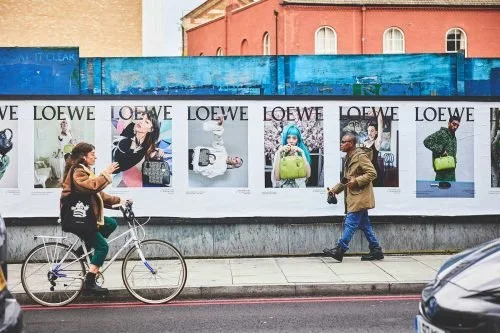
Imagery: @Loewe
Over the last decade, marketing has become a game of reach, frequency, and optimisation. Digital makes it incredibly easy to stay visible, but I wonder if that’s come at the expense of long-term brand building - the kind that isn't always easy to track in a spreadsheet but is essential for survival. What gets lost in the "scroll" is depth, memory, and emotional weight.
There isn’t a perfect success formula here. The right format always depends on the brand, the audience, and the context. But our understanding of human behavior, and our cognitive biases, is a much more reliable North Star. It’s helpful to stop thinking about "consumers" for a second and just think about humans. Not every interaction with a brand happens when someone is ready, or even willing, to spend.
Most digital advertising finds us while we’re in the middle of doing something else. It’s an unskippable video, a pop-up, or a sponsored post. It is, by definition, an interruption. Over time, this has made us highly aware of being marketed to. We’ve become skeptical and resistant. It means many brands are actually starting at a disadvantage in digital spaces; they are shouting at an audience that is already on guard and looking for the "skip" button.
Print doesn’t trigger the same response. It has been dismissed in recent years as outdated, with budgets shifting towards channels that prioritise impressions, and are easier to measure and optimise. But its strength lies in the fact that it behaves differently: It doesn’t compete for attention in the same way.
Whether it’s something arriving through the door, a flyposter, a leaflet or a well-placed piece of OOH, the interaction feels less intrusive. People aren’t being pulled away from something else, and they’re not being asked to act immediately.
When a prospective customer is served a print activation in a day-to-day environment, it tends to have their full attention, even if only briefly. It’s a very different level of focus compared to something that can be dismissed with a quick swipe.
There’s also a broader behavioural consideration. Digital environments are full of small, constant prompts to act. Click, swipe, skip, decide. Each one is minor on its own, but collectively they create a steady stream of micro-decisions that build unconscious friction, and over time can contribute to fatigue or even low-level stress that the user subconsciously associates with the brands causing it.
Print removes that pressure. There’s no time-pressured call to action. People can take it in at their own pace or ignore it entirely without consequence. That change in pace changes how the message is received. Research suggests physical media is actually easier for our brains to process. It creates stronger emotional responses and is significantly more memorable. For luxury, where "top of mind" is everything, that’s a huge competitive advantage.
Beyond memory, there is the issue of trust. Digital ads are shaped by data in ways that are becoming increasingly visible to the people we’re trying to reach. People know when they’re being targeted, and that awareness can feel uncomfortable. Print feels more neutral, more deliberate. It is tangible; it exists in the real world. In a landscape where everyone is fighting over the same pixels, a well-executed physical piece stands out because so few brands have the confidence to do it anymore.
In luxury, print acts as a signal. A high-quality physical piece implies brand health. It suggests a house is willing to invest in something that isn’t purely driven by next-week’s metrics. That, in itself, reinforces the perception of quality and strength.
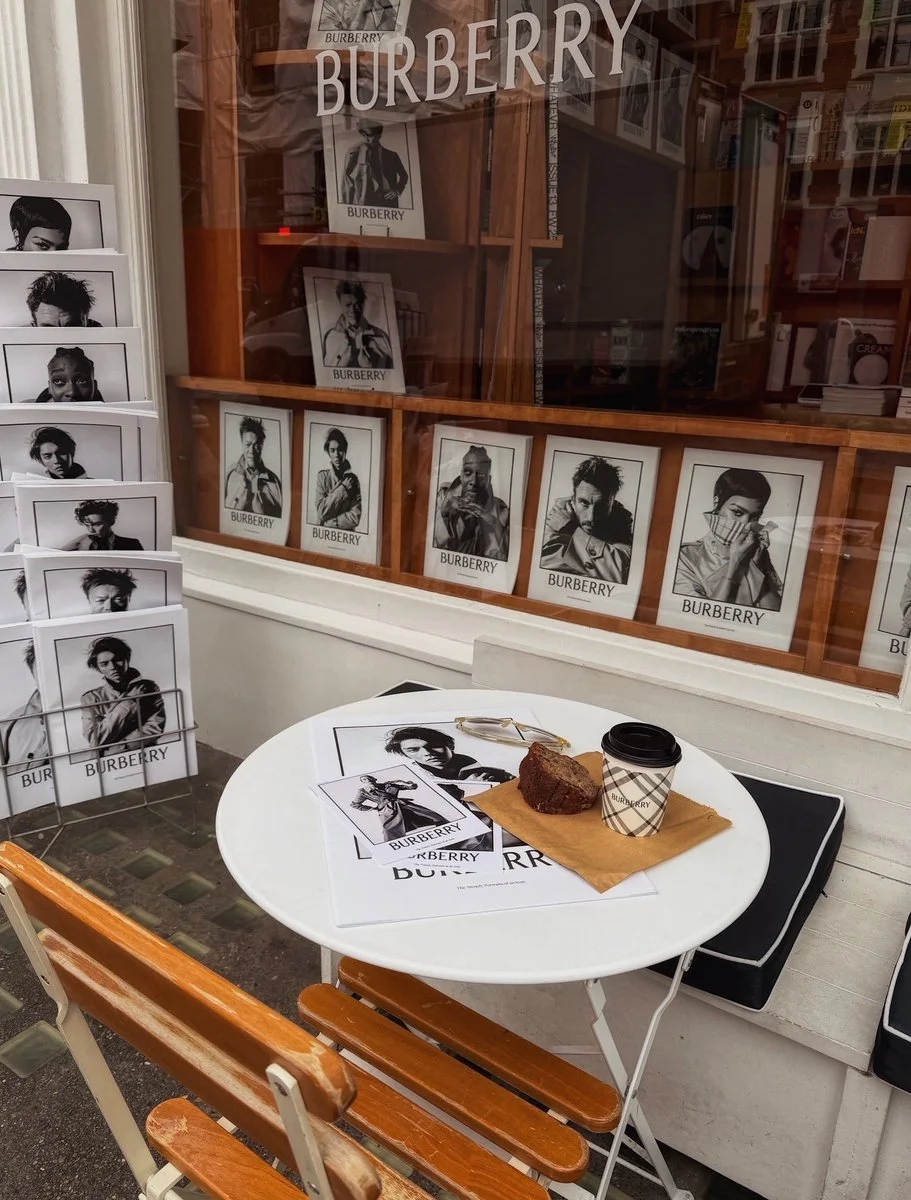
Imagery: @BrightsDarling
This doesn’t mean digital is the problem. It isn’t. Digital is extremely effective at creating visibility and driving immediate action. The opportunity lies in how it works alongside physical formats.
Net-a-Porter’s PORTER magazine shows how print and commerce can work together, combining editorial content with direct pathways to purchase. Burberry has also explored ways to connect physical formats with digital experiences, using print as a starting point for deeper engagement. In each case, print is not being used to maximise reach, it is being used to bolster wider activity and reinforce meaning.
A useful example outside of the luxury category comes from Hiscox, who ran an integrated campaign using direct mail, digital, press and out-of-home with format-specific creative. The campaign led to significant uplifts in brand awareness and search activity, alongside record commercial performance. The print grabbed the attention and built a sense of respect and positivity. When the consumer later saw the campaign in a digital space, they recalled that positive physical response. It bypassed the uphill battle of digital resistance because the trust and respect had already been established in the real world.
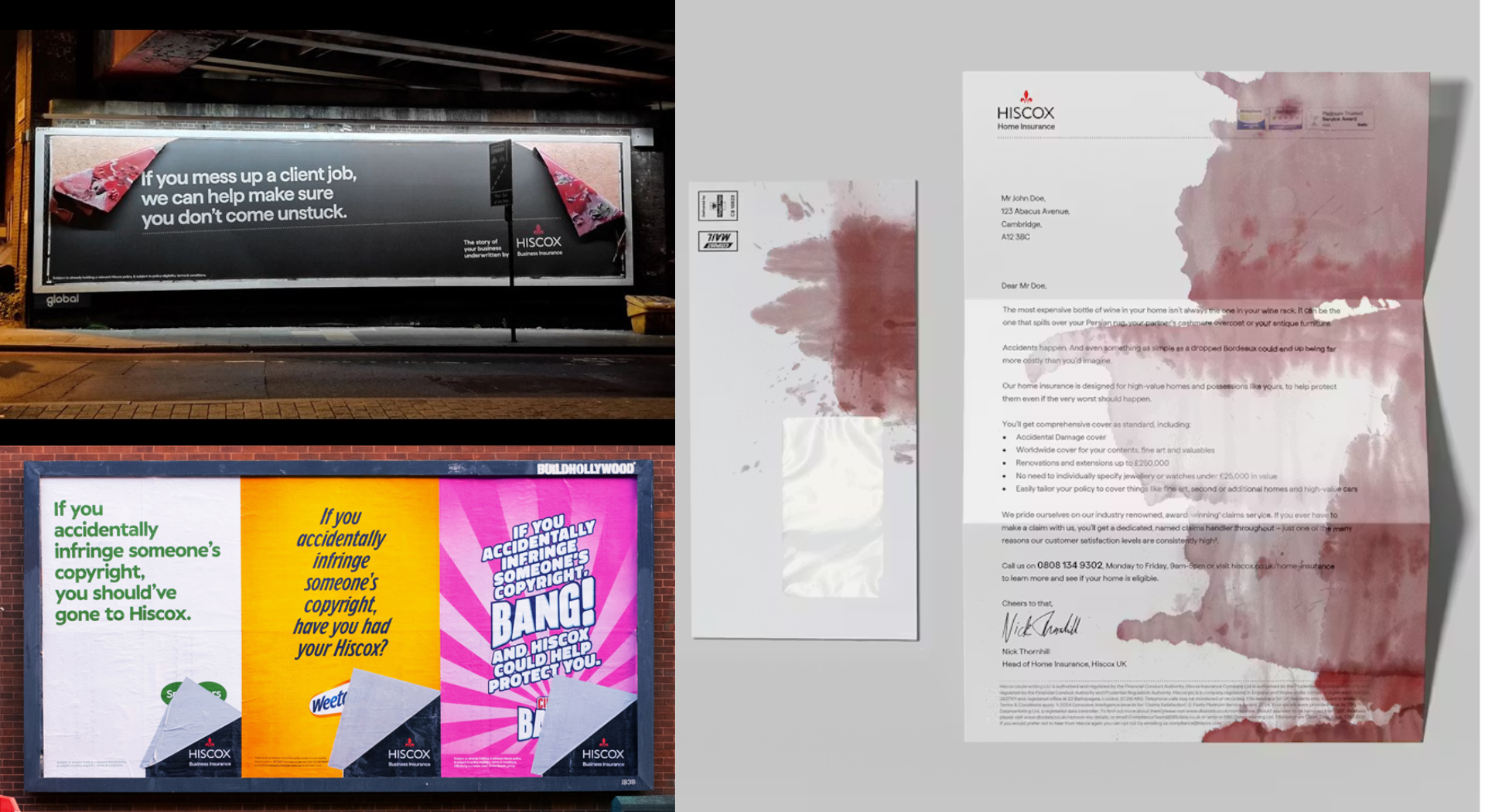
Imagery: @hiscoxinsurance
For luxury brands, this opportunity remains mostly unexplored for how print can contribute to their broader marketing ecosystem, but where reputation and loyalty is hugely important for these brands, print can have an incredibly positive impact when integrated into wider campaigns - especially when its strengths are utilised to maximise effectiveness.
For many brands, this may require a shift in how efficiency is defined. Cost per impression and cost per click are useful short-term metrics, but they don’t capture everything that matters in a luxury context. A smaller number of well-placed, well-crafted interactions can be more valuable than a high volume of low-attention ones. Print naturally supports that approach. It is more selective, it tends to appear in higher-attention environments, and it continues to have an effect beyond the initial moment of exposure. A shift is required away from focussing on how cheaply a brand can reach more people, to how effectively it can influence the right ones.
The brands getting the most out of this are not thinking in terms of individual channels. They are thinking about how different formats work together. Where digital brings speed, scale and immediacy, physical formats bring depth, trust and memorability. The value for brands then comes from how those strengths are combined.
Used well, it creates moments where people are more open, more attentive, and more likely to remember. For luxury brands, that kind of impact is central to how long-term value is built.
Curious about exploring print and digital production solutions for your next brand campaign? Contact enquiries@leap.luxe for expert advice across luxury brand executions on a global scale.